Germany ranks among the world’s most popular destinations for international students and skilled professionals. Yet if you’re mapping out your future from outside the EU, one crucial question often emerges:
Should you pursue a vocational Ausbildung or opt for a Bachelor’s or Master’s degree in Germany?
Both routes open doors to success, but they differ significantly in structure, objectives, career trajectory, and day-to-day experience. This guide breaks down everything you need to know to make an informed, confident choice.
What Is Ausbildung in Germany?
Ausbildung is Germany’s dual vocational training system. It combines hands-on work experience at a company with theoretical learning at a vocational school (Berufsschule). You train directly in a real workplace, developing practical job skills while earning a salary.
Key Facts About Ausbildung:
- Duration: 2 to 3.5 years, depending on the profession
- You earn while you learn: Trainees receive a monthly stipend from their employer, typically ranging from €800 to €1,500 or more depending on the field
- Dual learning approach: Your training includes both on-the-job experience and classroom instruction
- Employment contract: This is a paid position with a formal job contract, not just academic study
- No tuition fees: In most cases, your employer covers all training costs
High-Demand Ausbildung Fields in Germany (2026)
Germany faces major skill shortages in several sectors, especially nursing and healthcare, IT, engineering, logistics, and skilled trades. In these high-demand fields, Ausbildung often offers faster entry into the workforce compared to university studies. Many companies actively recruit trainees in these areas due to a lack of skilled workers.

After completing your Ausbildung, most trainees receive job offers from the same company. This qualification also makes you eligible for a work visa and can pave the way toward long-term residency in Germany.
Career Options After Ausbildung
Completing an Ausbildung does not limit you to one career level. Graduates can pursue advanced vocational qualifications such as the Meister, move into supervisory or specialist roles, or continue with further studies. In some cases, Ausbildung graduates can even enter university programs, sometimes receiving credit for prior training.
Alternative Path: Dual study programs (Duales Studium)
Germany also offers dual study programs (Duales Studium), which combine a university degree with paid practical work at a company. Students earn a salary while studying and gain real-world experience alongside academic qualifications. This option bridges the gap between Ausbildung and traditional university studies and is ideal for those who want both theory and income.
What About a Bachelor’s or Master’s Degree?
A Bachelor’s or Master’s degree is an academic program offered by universities. Rather than focusing primarily on job training, these programs emphasize theoretical knowledge, research, and broad subject expertise.
Important Things to Know:
- Duration: Bachelor’s programs typically take 3 to 4 years, while Master’s programs take 1 to 2 years
- Language options: Many programs are available in English, particularly at the Master’s level
- No salary during studies: Unlike Ausbildung, you won’t earn money while completing your degree
- Financial requirements: You’ll often need a blocked account or proof of funds to demonstrate you can cover living expenses
As of 2026, the standard blocked account requirement is €11,904 per year (approximately €992 per month).
Graduates with degrees are well-prepared for higher-level positions, leadership roles, and international career opportunities.
Side-by-Side Comparison
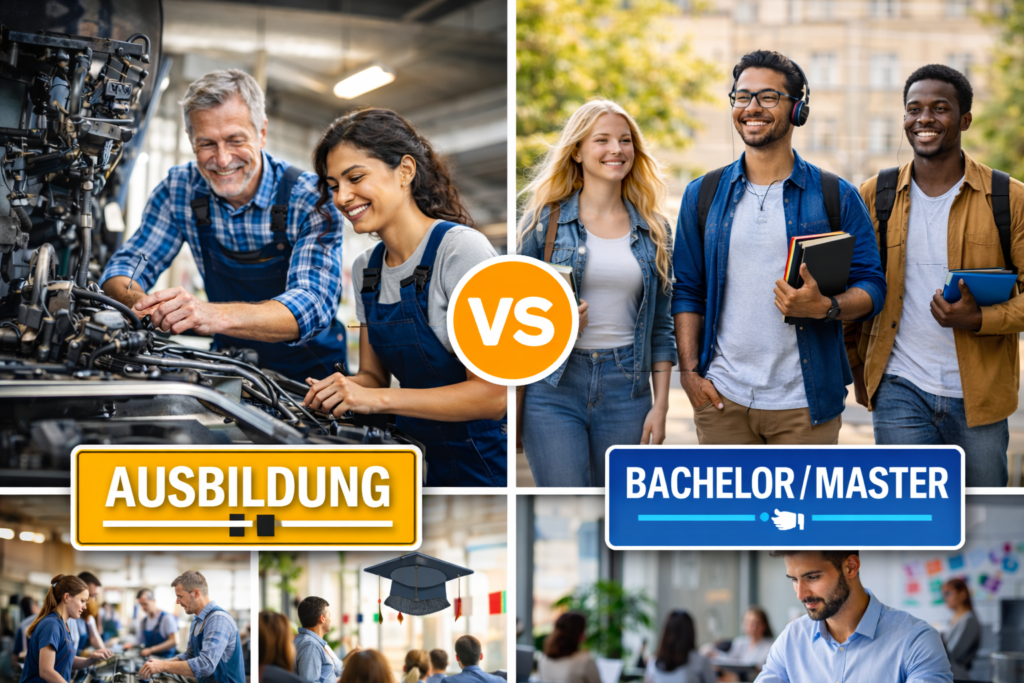
1. Language Requirement
- Ausbildung: Almost always requires German proficiency, typically at B1 to B2 level, while some fields accept A2 initially
- Bachelor/Master: Many degree programs are offered in English, so you may need only basic German or none at all initially
2. Money: Earn vs. Spend
- Ausbildung: You earn money from the start, with stipends typically ranging from €800 to €1,500 during training
- University: You’ll need to cover living expenses with no income until after graduation (blocked account required)
3. Visa specifics
For Ausbildung, you must first secure a training contract with a German company before applying for a visa. Once you have the contract, you apply for a vocational training visa. If your monthly stipend meets the minimum living cost requirement (for example, around €1,048 gross per month in 2026), you may not need a blocked account or may only need a limited one.
For Bachelor’s or Master’s studies, a student visa is required, and in most cases a blocked account is mandatory to prove you can cover living expenses. This makes the university route financially heavier at the beginning compared to Ausbildung.
For university students, the blocked account is standard and almost always mandatory, while for Ausbildung it is often waived if the training salary meets the minimum living requirement.
4. Employment Timeline
- Ausbildung: You begin working from day one and gain hands-on work experience immediately
- University: Employment starts after completing your degree, usually 3 to 4 years later
5. Job Placement After Completion
Ausbildung programs have very strong job placement outcomes. Industry and vocational reports commonly indicate employment rates of roughly 85–96% shortly after completion, often by the same company where they trained. This practical-to-job transition is typically faster than for university graduates, who may need more time to enter the job market.
6. Salary After Completion
Ausbildung graduates typically start at around €2,500 to €4,000 or more, depending on field, region, and employer. University graduates often command higher starting salaries, especially in sectors like technology, engineering, and research.
Both paths offer advancement potential over time, but degrees frequently provide access to higher earning ceilings.
5. Career Growth
- Ausbildung: Ideal for careers requiring hands-on, practical skills such as healthcare, mechanics, or IT specialist roles
- University: Better suited for careers demanding deeper theoretical knowledge, research capabilities, or leadership positions
Which One Is Better for You?
Age and Eligibility Considerations
Ausbildung programs are generally most suitable for applicants between 18 and 35 years old, although exceptions exist. University programs are more flexible in terms of age, making Bachelor’s and Master’s degrees a better option for older applicants or career changers.
Choose Ausbildung if:
- You want to start earning money immediately
- You prefer hands-on training over classroom-based theory
- You need a financially accessible pathway
- You plan to work and settle in Germany quickly
Choose a Bachelor’s/Master’s Degree if:
- You’re aiming for advanced academic and professional growth
- You want international job opportunities or leadership positions
- You can manage living expenses during your studies
- You prefer broader career flexibility and options

Common FAQs
Do Ausbildung students get paid while training?
Yes. Trainees receive a monthly salary (stipend), typically ranging from €800 to €1,500 or more throughout the program.
Is German required for Ausbildung?
Almost always. Most Ausbildung programs require B1 or B2 level German proficiency because both the training and workplace communication are conducted in German.
Can international students get permanent residency after Ausbildung?
Yes. After completing your Ausbildung and working for a designated period, you can qualify for a residence permit and eventually permanent residency.
Are university degrees internationally recognized?
Yes. Bachelor’s and Master’s degrees from German universities are widely recognized around the world and offer strong international career mobility.
Which option has better long-term income potential?
Degrees generally lead to higher long-term earning potential, particularly in fields like engineering, finance, and technology. Vocational careers may reach their income peak earlier unless combined with advanced qualifications or certifications.
Final Tips Before You Decide
Consider these important points as you weigh your options:
- Research your field carefully. Training and job opportunities in Germany vary significantly by industry—some sectors offer more openings than others.
- Start learning German early. Strong German language skills will benefit you whether you choose Ausbildung or university, opening more doors and easing your transition.
- Think about your long-term career vision. Consider whether you’re aiming for global career mobility or specialized local expertise, as this will help guide your decision.
Choosing between Ausbildung and a Bachelor’s or Master’s degree is an important decision!
If you’re still unsure which path is right for you, the team at AccessFuture can help you explore your options based on your background, goals, and eligibility. Visit the AccessFuture website or reach out through the Contact Us page to get personalized guidance and take your next step with confidence.