
University application mistakes are one of the biggest reasons students receive rejection letters. Getting a rejection letter stings, especially when you’ve spent weeks preparing your application. The good news is that most rejections happen because of small, avoidable mistakes.
Here’s something that might make you feel a little better: most university rejections have nothing to do with how smart or capable you are. More often than not, they come down to small, fixable mistakes in the application process itself.
If you’re applying to study in Germany or anywhere in Europe, this guide walks you through the most common university application mistakes students make and exactly how to dodge them, so your hard work actually gets the shot it deserves.
1. Applying Without Checking If You Actually Qualify
This is one of the most common university application mistakes students make. Every year, thousands of students apply to programs they don’t technically meet the requirements for and get an automatic rejection before anyone even reads their motivation letter.
Universities are usually pretty specific about what they want to see, including:
- A minimum GPA or CGPA
- Certain prerequisite courses or subjects
- Language proficiency scores
- A relevant academic background
- A minimum number of ECTS credits (this trips up a lot of master’s applicants)
Say you’re applying for a Computer Science master’s, many programs expect you to already have coursework in math, algorithms, or programming under your belt. No matter how strong your grades are elsewhere, missing that background can be an instant dealbreaker.
Do this instead: Before you fall in love with a program, read its admission requirements line by line. If something’s unclear, email the admissions office and ask, it’s a normal thing to do, not an annoying one.
2. Missing the Deadline (Even by a Few Minutes)
German universities do not do “late but close enough.” Submit your application even a few minutes after the deadline, and it’s often rejected automatically, no exceptions, no sob stories.

One of the most overlooked university application mistakes is underestimating how long document preparation takes to gather everything: transcripts, certified translations, language certificates, credential evaluations. These things take weeks, not days.
Do this instead: Start your prep at least 3-4 months before the deadline. Set your own personal deadline a week earlier than the real one, just in case something goes sideways.
Missing deadlines is one of the easiest university application mistakes to avoid with proper planning.
3. Submitting Documents That Don’t Meet the Fine Print
Here’s the part nobody really warns you about: it’s rarely about forgetting to attach a file. Most applicants know they need a transcript, a CV, a language certificate. The problem is usually in the details and universities won’t email you to fix it. They’ll just quietly reject the application.
Things that trip up even well-prepared applicants:
- A transcript that’s a plain photocopy instead of an officially certified or attested copy
- A translation done by a non-certified translator (many universities only accept sworn/certified translations)
- Documents that are certified, but the certification has expired or isn’t recognized by that specific university
- A CV or motivation letter that isn’t signed or dated where required
- Recommendation letters submitted as a plain email instead of on official letterhead, or missing the recommender’s signature and contact details
- Files uploaded in the wrong format (a scanned JPEG when a single combined PDF was required, for example)
- An APS certificate that’s still “in process” at the time of submission, rather than fully issued
Do this instead: Don’t just check whether you have a document, check whether it meets that university’s exact standard for it. Re-read the requirements for certification, translation, and format for each document, and confirm with the admissions office if anything is ambiguous before you submit. Double-checking every document helps you avoid costly university application mistakes.
4. Assuming “English-Taught” Means Language Isn’t an Issue
Assuming that “taught in English” means language requirements don’t matter is another common university application mistake. In practice, it’s only half the story, and a few overlooked details here quietly cause a lot of rejections.
- German requirements can still apply. Many English-taught programs still expect some basic German, often just A1 or A2 level for daily life, paperwork, or the occasional elective that isn’t offered in English.
- Not all English tests are treated equally. Universities are usually specific about which tests they accept, and the required score can differ from one program to the next, even within the same faculty. Don’t assume a score that worked for one program will automatically work for another.
- Test scores expire. Most language certificates are only valid for two years from the test date. A score that once cleared the bar can quietly become invalid by the time you apply.
- Waivers exist, but they’re not automatic. If your previous degree was taught entirely in English, many universities will waive the language test, but only with official proof, like a letter confirming the medium of instruction. Assuming the waiver applies without submitting that proof is a common, avoidable mistake.
- Requirements can vary by faculty, not just by university. A language requirement on the general admissions page doesn’t always match what a specific department asks for.
Do this instead: Look up the language section for your specific program, not the university’s general admissions page, and confirm the accepted test, minimum score, and validity window. If you’re relying on a waiver or an older certificate, get written confirmation from the admissions office before you submit.
5. Recycling the Same Motivation Letter for Every School
Admissions officers read hundreds of these letters. They can spot a copy-paste job from a mile away, especially when you forget to change the university’s name (it happens more than you’d think).
A motivation letter that actually works answers:
- Why this program, specifically?
- Why this university, and not just any university?
- How does your background actually prepare you for it?
- Where do you see this taking you afterward?
Do this instead: Treat every letter as a fresh one. It takes more time, but a genuine, tailored letter says “I actually want to be here” and that matters more than you’d expect.
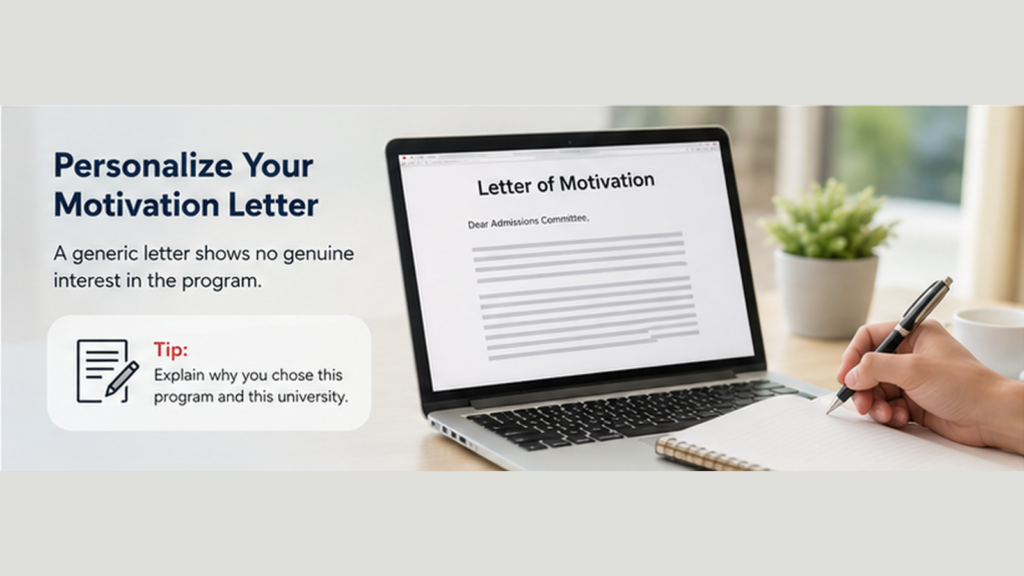
Writing a strong, personalized letter for every single university can eat up a lot of time and energy, especially when you’re juggling several applications at once. If you’d rather not do it alone, our team offers one-on-one motivation letter writing support, tailored to your background and each specific program, so every letter you submit actually sounds like you and fits the university you’re applying to.
6. Putting All Your Eggs in One Basket better
Applying to just one university is another common university application mistake, especially for competitive programs. In reality, it’s risky. Seats are limited, competition is fierce, and even genuinely strong applicants get turned away simply because there wasn’t room, not because of anything wrong with their profile.
It also means one small documentation slip or an unlucky admissions cycle can end your plans entirely, with no backup in motion.
Do this instead: Apply to a handful of universities that realistically match your profile, a couple of reach schools, a couple of solid matches, and one or two safer bets. Just keep an eye on each university’s individual deadlines and document requirements, since applying to more than one only helps if every application is actually complete and on time.
7. Applying to a Program That Doesn’t Match Your Background
This one’s heartbreaking because it’s so avoidable. Examples that come up constantly:
- A business graduate applying for Mechanical Engineering
- A biology graduate applying for an AI program with no coding background
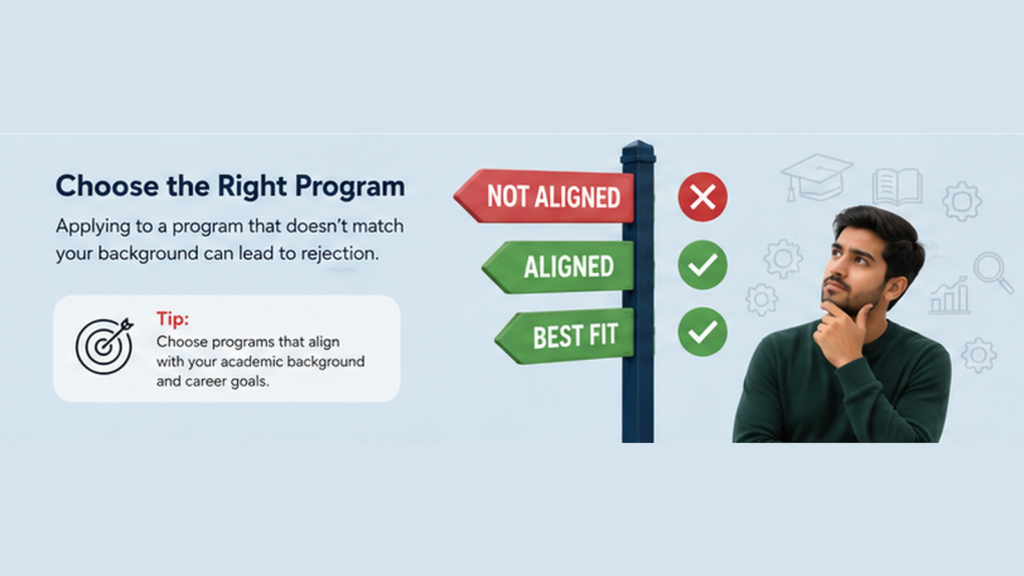
German universities in particular expect a clear, logical link between your bachelor’s degree and the master’s you’re applying for.
Do this instead: Pick programs that build on what you’ve already studied or, if you’re pivoting, be ready to show relevant coursework, certifications, or projects that bridge the gap.
8. A CV That Doesn’t Do You Justice
Your CV is often the first thing an admissions officer skims. If it’s cluttered, outdated, or hard to follow, it quietly works against you, even if your actual experience is solid.
A strong academic CV clearly lays out:
- Education
- Work experience
- Internships
- Research
- Projects
- Certifications
- Skills
Do this instead: Keep it clean, keep it current, and keep it scannable. One well-organized page (or two, max) beats five cluttered ones every time.
Building a CV that actually highlights your strengths instead of just listing everything you’ve ever done is harder than it looks, especially when you’re trying to make it fit an academic format.If you’d like some guidance, AccessFuture provides an individualized CV-writing service tailored to your background and the programs you’re applying to
9. Not Following the University’s Specific Instructions
Every university does things a little differently, and it’s easy to assume that once you’ve figured out one application, you’ve figured them all out. That assumption trips up a lot of applicants.
Some use Uni-Assist, others have their own portal. File formats and naming rules vary, one might want a single combined PDF, another separate files with specific names. Certification requirements differ too: a scanned certified copy might be fine for one university, while another wants the physical copy mailed separately. Even within the same university, one faculty’s process can differ slightly from another’s.
Do this instead: Read the instructions for each university and ideally each program separately, even if you’ve already applied elsewhere. A quick notes file per university with its portal, format rules, and any extra steps goes a long way.
10. Leaving Everything Until the Last Minute
Rushing almost always leads to the same avoidable slip-ups:
- Uploading the wrong file
- Forgetting a document
- Typos in important fields
- Missing small but critical details
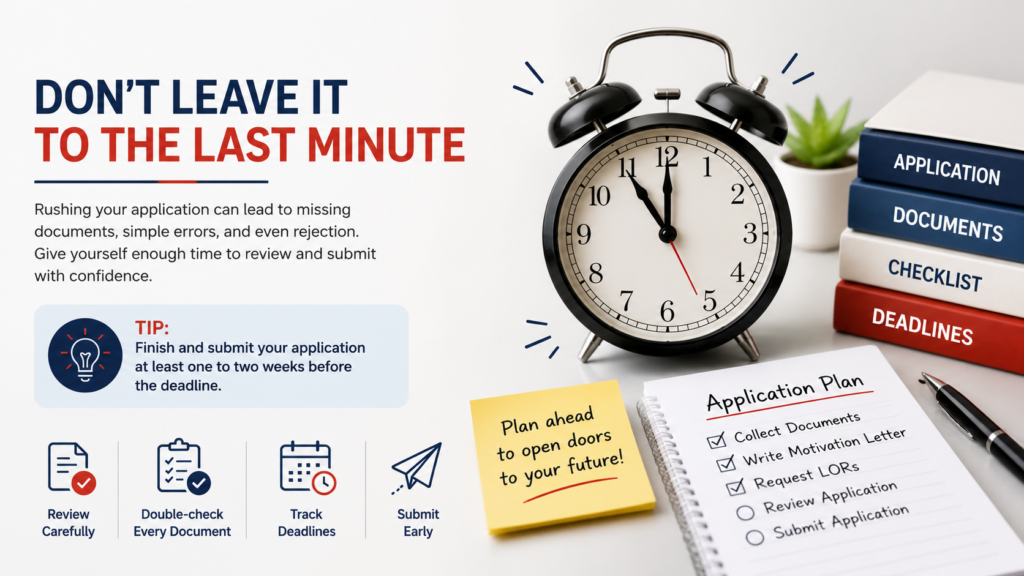
Do this instead: Aim to have everything finished and submitted at least one to two weeks before the actual deadline. Future you will be grateful.
The Bottom Line
A rejection letter doesn’t mean you’re not good enough. Most of the time, it just means something small a missing document, a mismatched program, an overlooked requirement got in the way.
The fix isn’t complicated: research thoroughly, start early, personalize everything, and double-check before you submit. It’s not glamorous advice, but it works.
If you’re still unsure about your profile or which programs actually fit you, talking to someone with admissions experience before you apply can save you a lot of wasted effort and a lot of unnecessary heartbreak.
And honestly, avoiding these mistakes only helps if you’re aiming at the right target in the first place. Before you get into deadlines and documents, it’s worth stepping back and asking: which programs actually match your profile? Which universities make sense for your grades, background, and budget? What are your realistic options? A free profile evaluation with Access Future can help you answer these questions early, so the rest of your application is built on the right foundation from the start.