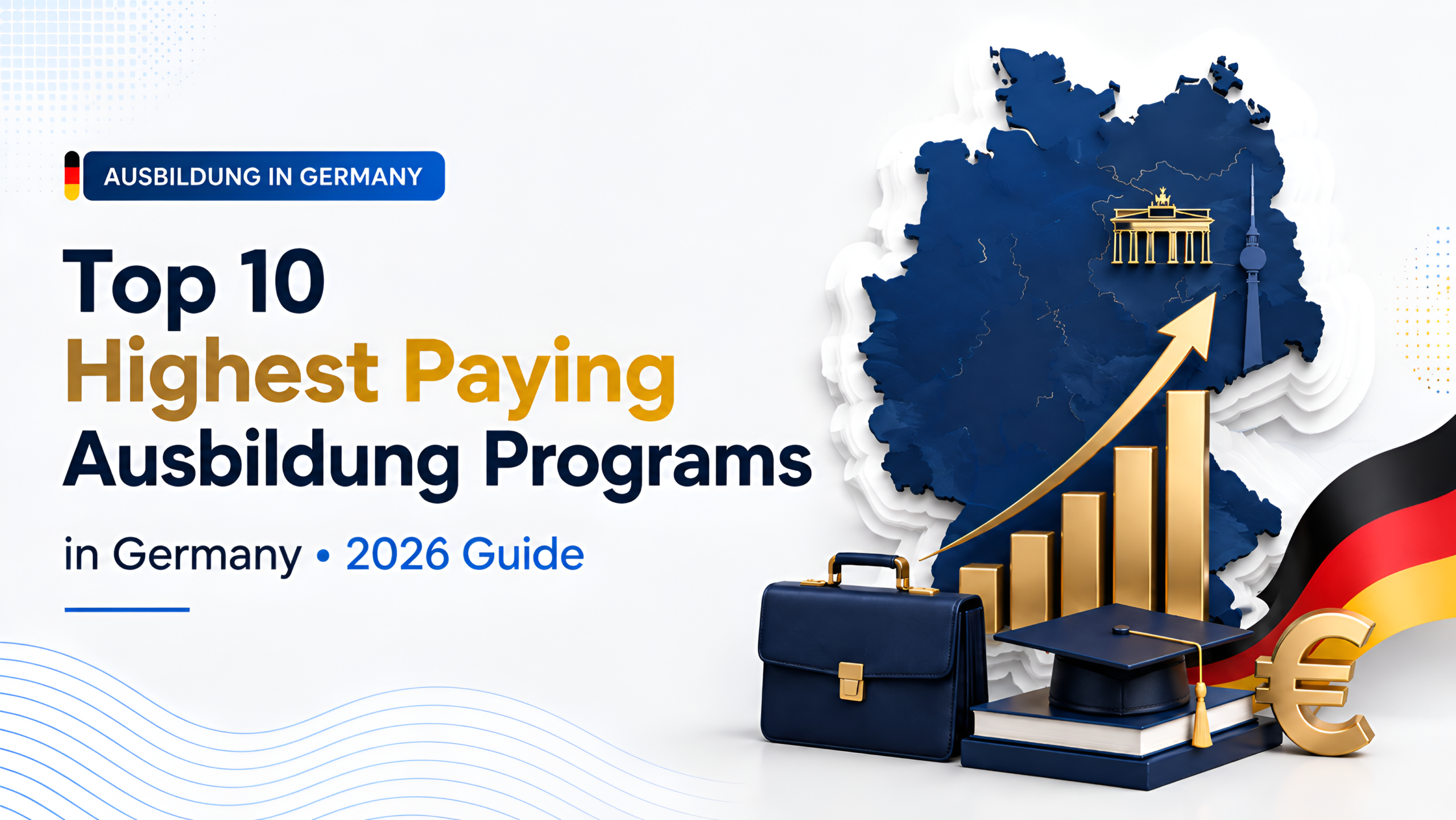
Choosing an Ausbildung in Germany is not just about picking a trade you find interesting. Pay matters too, especially if you are relocating from abroad and need to cover rent, food, and daily costs on a training wage. The good news is that some Ausbildung programs pay considerably more than others, and the gap between the lowest paid and highest paid trades has grown wider as certain industries compete hard for apprentices.
As of January 2026, every recognized Ausbildung in Germany carries a legal wage floor known as the Mindestausbildungsvergütung. It starts at 724 euros a month in year one and climbs to 1,014 euros by year four. That is the absolute minimum. Under collective bargaining agreements, the average training wage across all sectors sits closer to 1,133 euros a month, according to the Federal Institute for Vocational Education and Training (BIBB). The ten programs below sit well above both of those benchmarks.
All figures are gross monthly amounts and are drawn from a mix of collective wage agreements (Tarifverträge), employer job listings, and salary data portals current as of mid-2026. Actual pay still depends heavily on your employer, region, and whether that employer is bound by a collective agreement, so treat these as realistic ranges rather than fixed numbers.
A word of caution before relying on any of this for a real decision. German Ausbildung pay is split across hundreds of separate regional and sector tariffs, several of which were renegotiated during 2025 and 2026 alone. Two training routes into the same profession, such as the practice integrated and classical school based paths into early childhood education, can pay very differently even within the same city. Treat every figure below as a starting point for your own research, and confirm the exact number with the specific employer, chamber (IHK or HWK), or vocational school before making a decision.
With that context in mind, here is how the ten programs stack up against each other, before the detail on each one further down.
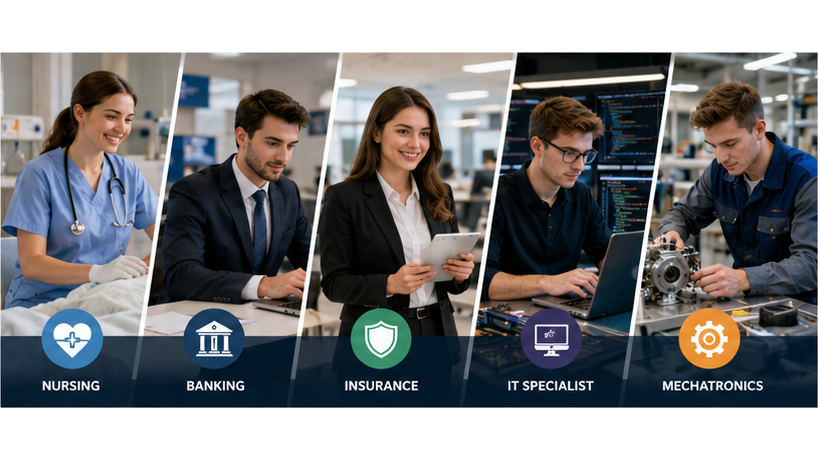
Quick Comparison Table
| Program | Training wage, year one | Training wage, later years | Typical salary after qualifying |
| Nursing (Pflegefachmann/frau) | around 1,340 to 1,490 euros | up to 1,653 euros by year three | around 3,400 to 4,300 euros |
| Banking (Bankkaufmann/frau) | around 1,060 to 1,400 euros | up to 1,620 euros by year three | around 2,800 to 3,300 euros |
| Insurance (Kaufmann/frau für Versicherungen und Finanzanlagen) | around 1,250 to 1,455 euros | up to 1,620 euros by year three | around 2,900 to 3,500 euros |
| IT Specialist (Fachinformatiker/in) | around 1,200 to 1,360 euros | up to 1,470 euros by year three | around 2,850 to 3,300 euros |
| Mechatronics (Mechatroniker/in) | around 1,200 to 1,380 euros | up to 1,690 euros by year four | around 3,300 to 3,700 euros |
| Industrial Mechanic (Industriemechaniker/in) | around 1,240 to 1,370 euros | up to 1,560 euros by year four | around 3,100 to 3,500 euros |
| Electrician (Elektroniker/in) | around 1,000 to 1,150 euros | up to 1,350 euros by year four | around 2,900 to 3,400 euros |
| Plumbing and HVAC (Anlagenmechaniker/in SHK) | around 900 to 1,010 euros | up to 1,175 euros by year four | around 2,800 to 4,100 euros |
| Construction | around 1,080 to 1,140 euros | up to 1,390 euros by year three | around 2,500 to 3,200 euros |
| Kindergarten Teacher (Erzieher/in), PiA route | around 1,140 to 1,415 euros | up to 1,650 euros by year three | around 3,500 euros |
Note: the kindergarten teacher figures above apply to the practice integrated (PiA) training route. The older, classical school based route pays nothing for the first two years and only starts paying, typically around 1,950 euros a month, during the final practical year.
1. Nursing (Pflegefachmann / Pflegefachfrau)
Nursing now tops the list of best paid Ausbildung programs, a shift driven by years of collective bargaining aimed at closing Germany’s care worker shortage. Under the TVöD public sector agreement, trainees earned 1,490.69 euros a month in year one as of May 2026, rising to 1,552.07 euros in year two and 1,653.38 euros in year three. Employers in the private and church affiliated sectors pay similar or slightly lower amounts depending on their own agreements.
Once qualified, Pflegefachkräfte typically start around 3,400 euros a month and can reach a median closer to 4,000 to 4,300 euros with a few years of experience, night, weekend, and holiday shift differentials.
Applicants generally need a recognized school leaving qualification and German at B1 or B2 level, since the job depends entirely on clear communication with patients and colleagues.
2. Banking (Bankkaufmann / Bankkauffrau)
Banking has long been one of the better paid commercial apprenticeships. Depending on the bank and the applicable tariff, first year training pay runs from roughly 1,060 euros at smaller regional banks up to 1,400 euros or more at larger institutions such as Deutsche Bank, climbing toward 1,550 to 1,620 euros by the third year in the strongest paying houses.
Entry level salaries after qualifying typically fall between 2,800 and 3,300 euros a month, with clear paths upward through further qualifications such as Bankfachwirt or a business degree.
Most banks look for a solid Mittlere Reife or Abitur, strong numeracy, and comfort with client facing communication.
3. Insurance (Kaufmann/Kauffrau für Versicherungen und Finanzanlagen)
Insurance sits close behind banking on the pay scale. Training wages under sector agreements run from around 1,250 to 1,455 euros in year one, rising toward 1,620 euros by year three at the top end of the scale, with a further increase for new contracts starting in September 2026.
After qualifying, average earnings across the profession sit around 43,000 to 60,000 euros a year, which works out to roughly 3,300 to 5,000 euros a month depending on region and role, with Hesse and other financial hubs paying noticeably above the national average.
The training suits people comfortable with detailed contracts, client advice, and ongoing product knowledge updates, since the profession keeps evolving alongside financial regulation.
4. IT Specialist (Fachinformatiker/in)
Germany currently has close to 150,000 unfilled IT specialist roles, and that shortage shows up directly in training pay. Under the metal and electronics industry tariff, which many larger IT employers follow, trainees can earn 1,200 to 1,360 euros in year one, rising to roughly 1,380 to 1,470 euros by year three. Companies outside that tariff often pay less, so it is worth checking which agreement an employer follows before accepting an offer.
Graduates typically start between 2,850 and 3,300 euros a month, with tariff bound firms and larger corporations sometimes offering upward of 3,500 euros from day one.
There are four specialisms to choose from, including systems integration, application development, and data and process analysis, so applicants with an interest in coding tend to gravitate toward the application development track, which usually pays slightly more.
5. Mechatronics (Mechatroniker/in)
Mechatronics blends mechanical engineering, electronics, and automation, and it is one of the strongest paid technical trades under the IG Metall tariff. Training wages typically start around 1,200 to 1,380 euros in year one and rise steadily to 1,500 to 1,700 euros by the fourth year at large industrial employers.
Once qualified, Mechatroniker earn a median salary in the region of 3,300 to 3,700 euros a month, with senior technicians reaching close to 3,900 euros.
Applicants usually need a solid grasp of maths and physics, along with genuine interest in how machines, sensors, and control systems work together.
6. Industrial Mechanic (Industriemechaniker/in)
Industrial mechanics keep production lines and manufacturing equipment running, and the trade pays similarly well to mechatronics under the same metal and electronics tariff. Training pay usually runs from around 1,240 euros in year one to 1,370 or 1,400 euros by the later years, depending on the specific tariff region.
Post qualification pay averages around 3,100 to 3,500 euros a month, with those working in chemical, pharmaceutical, or plastics manufacturing sometimes earning at the higher end of that range.
The role rewards precision and comfort working with measuring instruments, CNC machinery, and technical drawings.
7. Electrician (Elektroniker/in)
Electrician training usually runs four years and covers installing, inspecting, and repairing electrical systems in buildings, industry, or energy infrastructure. Training pay generally starts around 1,000 euros and climbs toward 1,300 to 1,350 euros by the fourth year, though the exact figure depends heavily on whether the employer is tariff bound and which specialization is chosen.
After qualifying, electricians commonly earn between 2,900 and 3,400 euros a month, with strong demand tied to Germany’s ongoing push to expand renewable energy and grid infrastructure.
Entry usually requires a school leaving certificate that includes mathematics, along with an interest in safety critical, hands on technical work.
8. Plumbing and HVAC (Anlagenmechaniker/in für Sanitär, Heizung, Klimatechnik)
Often shortened to SHK, this trade installs and maintains water, heating, and climate control systems. It is currently one of Germany’s most understaffed skilled trades, with more than 60,000 open positions nationwide, and that shortage is starting to push wages up noticeably.
Training pay varies more than most other trades on this list, ranging from around 700 to 1,010 euros in year one up to 950 to 1,175 euros by year four, largely because so many SHK employers are small craft businesses outside major tariff agreements.
Post qualification pay tells a different story. Average earnings sit around 2,800 to 4,100 euros a month, and specialists certified in heat pump installation or refrigerant handling often earn 10 to 16 percent more than general all-rounders.
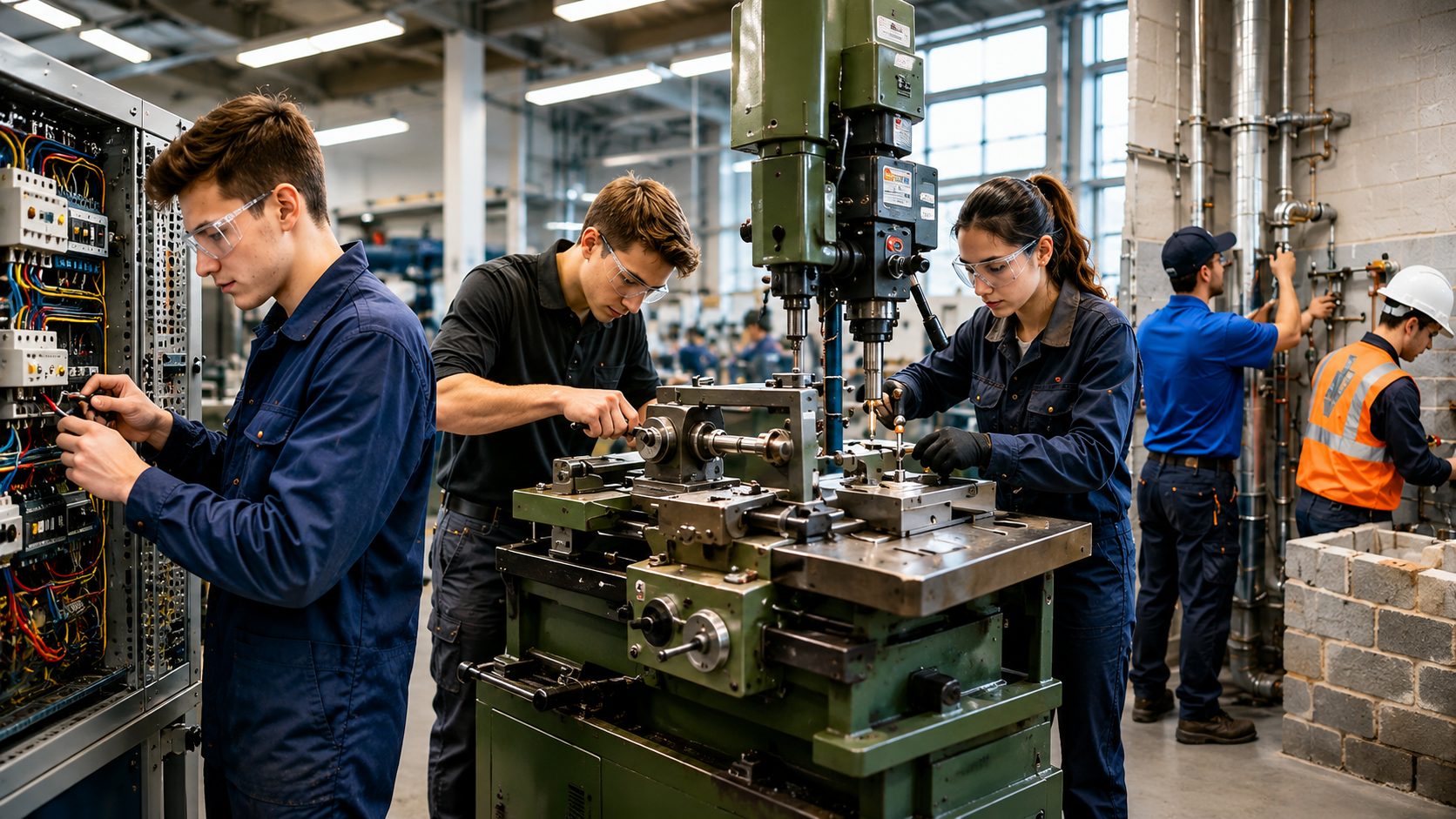
9. Construction
Construction training suits people who prefer working with tools, materials, and machinery over sitting at a desk. Under the main construction industry tariff (Bauhauptgewerbe), training pay was unified nationwide in 2025, ending the long standing gap between eastern and western Germany. Year one currently sits at roughly 1,080 to 1,140 euros, rising to around 1,270 euros in year two and about 1,390 euros in year three following the wage increase that took effect in 2026.
After qualifying, newly qualified skilled workers in construction trades typically earn somewhere in the region of 2,500 to 3,200 euros a month before additional site allowances, which many employers add on top of base pay. This figure varies more than most others in this guide, since actual pay is set by hourly tariff wage groups rather than a single fixed monthly salary.
Entry requirements are relatively flexible, ranging from a basic school leaving certificate to a technical diploma, and both first time applicants and career changers are commonly accepted.
10. Kindergarten Teacher (Erzieher/in)
Early childhood education is one of the few non-technical fields that lands in the top tier of Ausbildung pay, largely because Germany faces a persistent shortage of qualified childcare staff. How much a trainee earns, however, depends heavily on which of the two main training routes they take, and the difference is significant enough to affect a real decision.
Under the practice integrated route (praxisintegrierte Ausbildung, or PiA), trainees are paid from day one under a public sector linked tariff, roughly 1,140 to 1,650 euros a month depending on the training year and region, with some states such as Baden Württemberg paying toward the higher end of that range. Under the older, classical school based route, trainees generally receive no wage at all for the first two years and only start earning, typically around 1,950 euros a month, during the final practical recognition year (Berufspraktikum). Given that gap, applicants focused on income during training should specifically look for PiA programs rather than assuming all Erzieher training pays the same.
After qualifying, Erzieher/innen typically start around entry level pay group S8a of the public sector tariff, which works out to roughly 3,500 euros gross a month, with experienced staff and those moving into leadership roles such as Kita director earning noticeably more over time.
This route often asks for more upfront preparation than a typical company based Ausbildung, including a relevant school leaving qualification or prior experience in childcare or social work, so it is worth checking a specific program’s entry requirements and training route closely before applying.
How to Choose Between These Programs
The highest number on a pay table is not automatically the right choice. A few honest questions help narrow things down. Do you prefer technical, hands on work or people focused, communication heavy work. Are you comfortable with the German required for patient care or client advice, or would a technical trade with less direct client contact suit you better. Do you want a fast route into the workforce, or are you willing to add extra preparation, as with nursing or early childhood education, in exchange for stronger long term pay.

Matching your genuine strengths and interests to a trade makes it far more likely you will complete the training and build a lasting career, rather than dropping out halfway through a well-paid but poorly suited program.
If you are still deciding whether vocational training or university is the right path for you, you can also read our detailed guide on Ausbildung vs Bachelor’s and Master’s in Germany.
What Actually Moves Ausbildung Pay Up or Down
Two trainees in the same profession can end up on noticeably different pay because of several factors working together.
Whether the employer is bound by a collective wage agreement matters more than almost anything else, since tariff bound companies routinely pay 20 percent or more above non-tariff employers. Region plays a large role too. Bavaria, Baden Württemberg, and Hesse generally pay above the national average, while parts of eastern Germany tend to sit closer to the legal minimum. Company size, shift work allowances, and any prior qualifications or relevant work experience also shift the number up or down.
It is also worth remembering that every figure in this guide is gross pay. Most first year trainees pay little to no income tax, since annual training pay usually stays below the 2026 basic tax free allowance of roughly 12,096 to 12,348 euros. Social insurance contributions, covering health, pension, unemployment, and long term care insurance, still come out of gross pay and total around 18 to 20 percent.
Basic Eligibility for International Applicants
Requirements vary by trade and employer, but most international applicants will need the following.
A recognized school or vocational qualification from their home country, German language ability generally around B1 or B2, a properly prepared CV and application documents, a signed Ausbildung contract from a German employer, and proof that they meet the requirements for the training visa (Ausbildungsvisum) under section 16a of the Residence Act. A blocked account is not required for this visa category, though applicants should confirm current financial proof requirements with the German mission handling their application, since these details are occasionally updated.

Some trades layer on extra conditions. Nursing programs often ask for a relevant prior qualification, technical trades frequently expect solid mathematics grades, and early childhood education may require documented experience working with children.
Is Ausbildung Still Worth It in 2026?
For most applicants, yes, provided the decision is not based on salary alone. The real advantages are concrete. You are paid from day one, you gain hands on experience inside an actual German workplace, you finish with a nationally recognized qualification, and in fields facing serious shortages such as nursing, IT, and skilled trades, job security after graduation tends to be strong.
That said, language ability, whether the daily work genuinely suits you, and your longer term goals in Germany matter just as much as the number on a pay table. A high paying trade that leaves you miserable every day is rarely the better trade off.
Frequently Asked Questions
Which Ausbildung program pays the most in 2026?
Nursing currently leads in combined training pay and post qualification salary, followed closely by banking and insurance among the commercial trades, and mechatronics among the technical trades.
Do Ausbildung trainees actually get paid?
Yes. Every recognized Ausbildung includes a monthly training wage that rises each year, with a legal minimum currently starting at 724 euros in year one.
Is B1 German enough for a well-paying Ausbildung?
It is the minimum most employers ask for, but higher paying programs such as nursing and banking involve constant direct communication with patients or clients, so many successful applicants arrive with stronger practical German than the formal minimum suggests.
Can international applicants really get these high paying spots?
Yes, provided they meet the educational, language, and visa requirements for the specific trade. Fields facing labor shortages, including nursing, IT, and several skilled trades, are often the most open to applicants from abroad.
How long do these programs take?
Most run two to three and a half years. Electrician training and several industrial trades commonly run the full three and a half to four years, while some commercial apprenticeships can be shortened for applicants with strong prior qualifications.
Are the salaries listed here gross or net?
Gross. Net take home pay will be noticeably lower once social insurance contributions and, where applicable, income tax are deducted.
Final Thoughts
Nursing, banking, and insurance now offer the strongest combination of training pay and post qualification salary among the programs covered here, with mechatronics and industrial mechanics close behind for anyone drawn to technical, hands on work. Electricians, plumbing and HVAC specialists, construction workers, and kindergarten teachers round out a solid group of paths that combine decent pay with genuinely long term demand.
Before committing to any of these, look past the headline number. Check the actual job description, the employer’s specific pay agreement, the language requirement, and what your career looks like five or ten years down the line. The best Ausbildung is not simply the one with the highest number attached to it. It is the one that fits your abilities, your interests, and where you actually want to end up.
Choosing the right Ausbildung is an important decision, especially when you are applying from abroad. If you need guidance on understanding your options, preparing your application, or taking the next step toward Germany, the AccessFuture team is here to help you move forward with more clarity and confidence.